
Thursday, 1 April 2010

Final Album Cover/Digi-Pack
Here is the finished product, this is the album cover/digi pack. The front cover, back cover and spine.


Advert and Poster Research Evaluation
It was crucially important that we researched and analysed covers and advertisements because it allowed us to have a wide pool of ideas for our own work, and it showed us what works and what doesn't work. It also helped us to understand how images are placed in relation to the rule of thirds and in a nutshell, it gave us the knowledge base to produce a high quality promotional poster.
Wednesday, 31 March 2010
Advert/Poster Planning
After the process of researching various adverts and analysing them, i lifted the ideas we thought were effective and used them in conjunction with ours to plan out our advert. We planned various adverts portrait and landscape, and marked out the rule of thirds, and annotated what we wanted prop wise and editing wise on the plans.
As we planned for the front cover, in order to keep a consistent feel throughout the project we will use the background in the practice room. It again re-inforces the house style. We have various ideas for the advert in terms of what will be on the page, we might well use the plan of the guitar and amp, or have the album cover shot, or a variation to fill the advert, it could also be horizontal or vertical as the plans show.
We will use the same fonts we have used on the album cover and the titles of the video, these will be in bold like the adverts i researched, and most probably centralised on the page, in order to stand out and be the first thing the audience see. We will use italics for the reviews box, this is used frequently in a lot of adverts and differentiates the text within the same house style. We will also have the record label's logo and the band's logo in the dead areas, this will draw eyes to it and not just leave it with nothing there. I feel like filling this gap on the page almost adds a wall to the final design and boxes it all together.
We are leaving improvisation open for the actual image too, it will be of the band, but effects and other photoshop filters are open to be played around with.
As with most of the project we are leaving room for improvisation, we feel creativity is stimulated this way and fits with the conventions of the genre and Biffy Clyro.
Here are the sketches i did for the advert/poster.


Advert/Poster Research
During planning the album cover, i researched and gathered different promotional posters to pull and gather ideas for our poster. I trawled through NME magazines to get all the images and specifically chose posters from bands which fitted the same genres and target market. I cut all the posters out and then put together a collage of them all and annotated the individual posters within, analysing the positioning of images, the rule of thirds, house styles and colour schemes.
When i analysed the individual covers, i found that especially with the album advertisements, the house style was identical to the album covers, so therefore we must have the same house styles and colours, this is evident on the Kaiser Chiefs and Vampire Weekend adverts, this is partly because the album cover is the advert bar a few extra additions. This is potentially something we may do, use the same image as the cover, or a variation. The colours we use need to be in relation to the colours evident in the video and album cover, this will tie all the project together. House style will be evident throughout and it crucially important.
In addition, i also found that all the images were specifically taken in relation to the rule of thirds and were specifically placed in the editing process, or the taking of the picture, for example The Kills' advert. The image that we take needs to be in relation to the rule of thirds and the props or humans need to be in appropriate positions. In addition the overlays on photoshop will be placed in relation to the rule of thirds, utilising dead zones with logos and placing titles and review boxes in the best possible places. I will definitely utilise this in our advert poster.
The text fonts and style we use need to bold are punchy, they need to stand out and jump out the audience, perhaps in black, white or red. They need to identify what the poster is about and with the reviews, they need to sell the product. In order for our poster to attract the audience i will definitely use bold texts and emphatic font colours/fonts to utilise this effect.
Here are the examples of advertisements that i gathered and analysed.


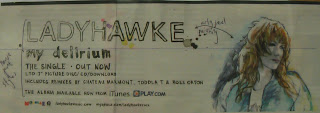


When i analysed the individual covers, i found that especially with the album advertisements, the house style was identical to the album covers, so therefore we must have the same house styles and colours, this is evident on the Kaiser Chiefs and Vampire Weekend adverts, this is partly because the album cover is the advert bar a few extra additions. This is potentially something we may do, use the same image as the cover, or a variation. The colours we use need to be in relation to the colours evident in the video and album cover, this will tie all the project together. House style will be evident throughout and it crucially important.
In addition, i also found that all the images were specifically taken in relation to the rule of thirds and were specifically placed in the editing process, or the taking of the picture, for example The Kills' advert. The image that we take needs to be in relation to the rule of thirds and the props or humans need to be in appropriate positions. In addition the overlays on photoshop will be placed in relation to the rule of thirds, utilising dead zones with logos and placing titles and review boxes in the best possible places. I will definitely utilise this in our advert poster.
The text fonts and style we use need to bold are punchy, they need to stand out and jump out the audience, perhaps in black, white or red. They need to identify what the poster is about and with the reviews, they need to sell the product. In order for our poster to attract the audience i will definitely use bold texts and emphatic font colours/fonts to utilise this effect.
Here are the examples of advertisements that i gathered and analysed.


Tuesday, 30 March 2010
Album Cover Plans
Following on from researching covers, we then planned out covers, drawing them out, marking them up with rules of thirds, and annotating what will be where on the covers, in doing this it will help us to not go off on a tangent when taking photos, these plans provide us with a basic outline of a few ideas to work from/to.
We will use the walls in the practice room to be the background for the album cover because it adds a sense of continuity from the video into the album cover, almost like a house style. It ties it all together. We have initially planned to have us sat on the floor as the plan states, but we're leaving room for improvisation regarding our positions and photoshop effects. We will be placed in relation to the rule of thirds regardless.
We plan to have the title of the album at the top in the middle, and will use the same font for it that we will use elsewhere in the project. Placing the title and band name in this area will make it stand out, which is vitally important with the cover.
We have a couple of plans for the back cover too, the initial ideas are that it will be the wall that the front cover is being taken on, with the song titles stuck to the walls in even spaces from top to bottom, then all the small print overlaid on photoshop elements. The second idea is that we have a setlist wrote out with all the tracks on it, like a gig situation, and a picture of this on a black background, once again with the small print overlaid on photoshop. We feel like this idea fits with the ethos of the genre too, the scruffy teenage bedroom vibe.
The spine of the digi-pack will the same background as the back cover, but with the band and album title overlaid in the same font as the front cover. It will also have the record label's logo on the bottom and Biffy Clyro's logo on the top.
Here are the sketches i drew out for the plan...


Album Cover Research
After we'd started filming the video, i started to conduct research into album covers for the digi-pack, i started to gather images of different band's covers that remained within the same genres/sub genres that Biffy Clyro sit within and got some Biffy Clyro covers too. I gathered all of the images and put them into a collage to display the range of styles we can take ideas from.
I then went on to pick individual covers and analyse them, and make annotations on the covers. All of the album covers fitted within the rule of thirds, which helps sections of the cover stand out and shine through. So when we would set up the shots for the cover, we knew that we were going to stick to rule of thirds and stand where the lines would be. Then when we layer up the titles and other logos, they would stand out on the cover and not be in random unnecessary places.
From analysing the covers, i gathered ideas on house styles and how the cover needs to have some common theme to it, that exists between adverts, front and back cover. This is evident on pretty much any album cover ever created so we need to have a house style. We will be sure to establish this over all the segments of the project including the titles in the video too.
Here are the images of the physical planning i did for this section.


Filming Lists/Plans
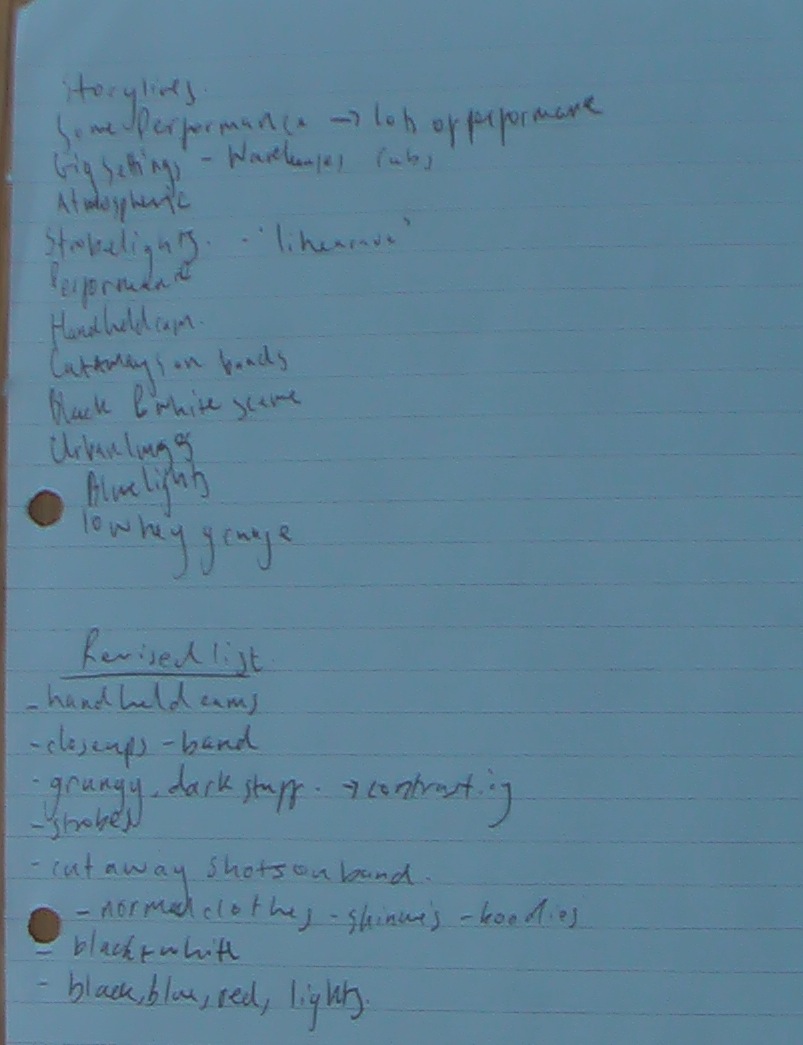
During the film-making process we wrote out lists and revised lists for the filming sessions. Here is one that summarises what we intended to include, following condensing the questionnaires and our own ideas, this helped us with drawing the story board and as a checklist during filming and editing sessions.
Story Board Evaluation
During the process of filming the video, lots of changes happened in our overall outlook on the video, we felt that we didn't need a story line, we purposely did this because we wanted to fit with the conventions of the genre more and also, videos with story lines can sometimes fell quite rigid and a little restrained, this allowed us to make a video that showcased the band more and it gave it more of a 'feel good' vibe to it. Although we changed some of the story board, we kept some of the same shots in there too, for example the slo-mo water cymbal shot and doing vocal shots in front of the poster wall.
As i said previously, it was important we put together the storyboard as it helped us stick to an outline and schedule for the video, and gave us the room also to roam free and do as we wished.
As i said previously, it was important we put together the storyboard as it helped us stick to an outline and schedule for the video, and gave us the room also to roam free and do as we wished.
Story Board
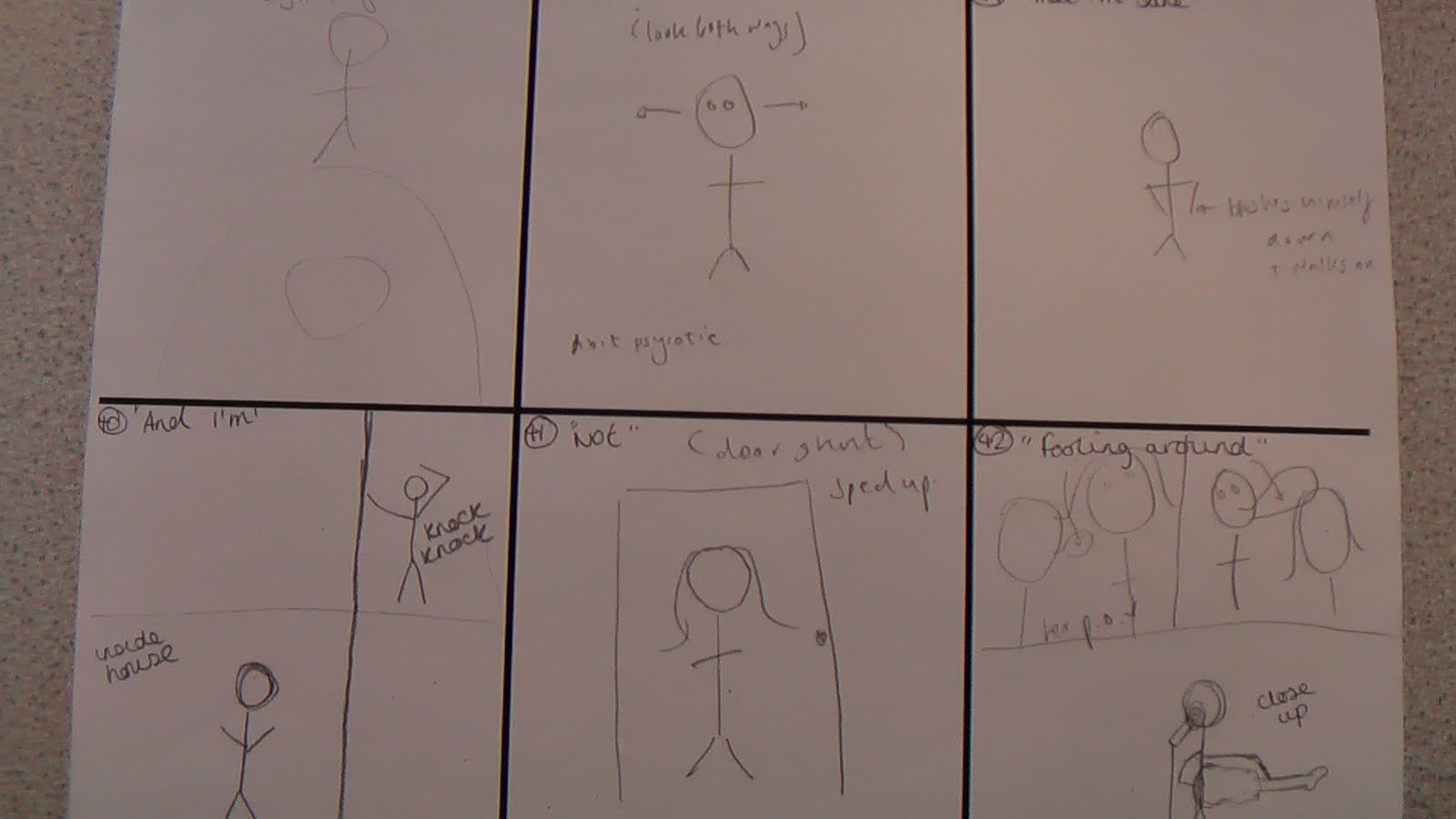
Following researching the various videos and gathering information from the audience, we started to plan our video out in story board form. We drew up a story board that left gaps open for us to flow behind the camera and add some spontaneity in there. We felt like this was important following the questionnaires saying that randomness should be included in the video, this is the best way to get it, by improvising. We initially planned a healthy mix of story line and band shots, following what was suggested in the questionnaire. We conducted the storyboard to help us have a plan of what shot types to use and a rough outline of what we wanted, to keep the project on a schedule.
*flows from bottom of page to top*


*flows from bottom of page to top*




Monday, 29 March 2010
Questionnaire Evaluation
We conducted the questionnaire in order to find out what we needed to include in the video, it's vitally important to the overall success of the video that we did this because in the end, theres no point making a video that no-one's going to feel interested by or captivated by it's content.
Following conducting and analysing the questionnaires, we have been lucky in the fact that a lot of the suggestions made by the audience were ideas that were fresh in our brains before planning the video in full. We will be sure to use some of the ideas suggested that fit with our concept of the video and this in turn should all being well captivate and interest the audience.
Following conducting and analysing the questionnaires, we have been lucky in the fact that a lot of the suggestions made by the audience were ideas that were fresh in our brains before planning the video in full. We will be sure to use some of the ideas suggested that fit with our concept of the video and this in turn should all being well captivate and interest the audience.
Questionnaires & Analysis
We composed a questionnaire for students in the lower school and the sixth form to complete, this was to get a very clear idea of what our target audience was interested in.
we established that our target audience was from the ages of 14-19, male and female.
The Questionnaire
1. Gender?
2. Age?
3. Favourite band?
4. Can you name your favourite music video?
5. What do you like to see in music videos?
6. What has impressed you in music videos recently?
7. Do you prefer performance based videos, narrative based videos or a mixture of both?
8. What sort of setting, mise en scene and lighting do you like to see in music videos?
summary of results:
Males seem to like.
Performance based videos/live videos. Dark lighting/club vibe. Randomness in videos. Lights/atmosphere. Band Shots. Mise en Scene, Warehouses, rural/urban settings. Hand-held cam shots. Black and white effect. Quick successive shots. Frequent Jump-cuts. Narrative/Easy to follow
Females seem to like.
Band performance. Mixtures of narrative & performance. Strobe Lights. Band shots. Narrative. Mise en Scene = Everyday situations. Storyline, ''Mini Drama''. Mood lighting to reflect the song
As me and my partner play in bands and have a big knowlage in the genre of music we are doing, i feel that we should do the video from a more band perspective, with lots of band shots, live shots and make the video funny and light hearted.
All of this information provides a wide pool of ideas to use that will meet the demands of the audience, i can be certain in saying that some of the above are certainly going to be utilised in the video, such as the hand held cam shots, the rural mise en scene, the warehouse vibe, and it feeling like a scruffy teenage setting. This links back to the conventions of the genre and the image surrounding alternative rock, grunge and Biffy Clyro.
In addition, i think we will try and incorporate a mixture of story line and band content, although i feel more inclined to base it round the band in the video only. We will also try and include a healthy dose of randomness into the video, to make it more fun and easy to enjoy. we will also try and use frequent jump cuts and a fast paced selection of camera angles/shots.
Thursday, 25 March 2010
Music Video Evaluation
I conducted research and analysed my findings in order to gather the most important aspects of each videos, for example, the use of frequent jump cuts to add variation and keep the audience captivated is something we must include if we decide to only include band shots in the video, although the varying shots would work equally well for a narrative too, in order add tension and build up suspense and pace in the video. Through conduction this research i have also gathered information on what sorts of mise en scene to use. To match the song we're using, and the target audience and the scene, the mise en scene should be quite rural and industrial. We will definitely follow this route in our video's setting.
In addition the use of panning shots and hand held cam shots are influential in the planning of our video, and will most certainly be used, i feel that help re-iterate the fact we're having a rural/industrial mise en scene, which gives the feeling of a scruffy teenager, which is what we wanted and the hand held cams really slot in with this theme.
Overall i have gathered a lot of info from the three videos and a lot of which will be included in our planning at least, and most probably in the final product
Thursday, 19 November 2009
Music Video Analysis
Biffy Clyro – Mountains
The video is mainly performance based; a lot of mid and close up shots are used throughout the video. These are effective because they showcase the bands energetic performances. This is something that will probably be used in our video due to the song being energetic.
Shots are changing frequently, and snap on to pushes in the music, these keep things hectic and up-beat. In order to keep our video fresh and interesting, I think successions of quick shots should be used.
The amount of seconds per shot varies throughout the video, nearer to the end, when the music gets busier, the amount of seconds per shot decreases rapidly, and at one point 3 shots are used in a one second space. There are times when one shot is held over 2-3 seconds as well. With the song in our video being quite up beat and poppy, the camera use will sway towards using more shots per second.
The transitions of shots during the band performance are snappy and look like hand held cam shots; they feel a little bit wobbly and swing around quite a lot. This could well be a shot type and transition we use in our video. Jump cuts are frequently used as well.
The four pictures above can provide an insight into the jump cuts, follow from left to right, then bottom left to bottom right and it shows type of cuts that are used and what sort of shots are linked together.
Twin Atlantic – What is Light? Where is Laughter?
The video is a healthy mix between band relaxation shots, live performances at Glasgow QMU and a staged performance set. The song is quite summery and it helps that the video style isn’t aggressive like the Mountains video, the blend of relaxation and live performance complements the song and the band very well.
There is frequent use of hand held cam angles during the band’s cutaways when they’re on the beach. This provides the effect that it’s home-made and personal; this might be a camera shot we use in our video, especially for the cut away band shots.
There is also frequent use of live shots, this would be really good to use if we could do it, and they show the energy the band has live, but there are also staged live shots later on, which are probably an easier thing to do. These still stage the bands live presence and is probably the favourable of the two live shots.
There’s a succession of jump cuts with different guitars that link in with the accents in the song. This part is very creative and unique; if we could incorporate something into the video it would look really good.
Kids In Glass Houses – Youngblood (Let it out)
This is an incredibly new video from the band and it showcases live staged performance. The director uses lots of jump cuts and varying shots to create variety and keep a relatively simple video, fresh and interesting. The use of lighting immediately appeals towards me and the use of flashes are something that would look good and effective.
The video is very simple, and low budget, so using ideas from it aren’t going to break the bank. The camera angles are very effective in keeping it fresh. It switches from long shot to close up, then mediums frequently. In the live performance in ours, a wide range of camera shots will be ideal in keeping the video exciting and fresh.
The main thing I’ll take from this video is the use of different camera shots to keep the audience captivated and keep it upbeat and exciting, it really works well in ‘Youngblood’ and I think it will in ours too.
We then researched various different camera shots, angles and transitions, not all of them will be used in the music video but we intend to use as many as possible.
Common shot sizes:
· Extreme close-up: Focuses on a single facial feature, such as lips and eyes.
· Close-up: May be used to show tension.
Medium shot: Often used, but considered bad practice by many directors, as it often denies setting establishment and is generally less effective than the Close-up.
Long shot
Establishing shot: Mainly used at a new location to give the audience a sense of locality.
Mise en scène" refers to what is colloquially known as "the Set," but is applied more generally to refer to everything that is presented before the camera. With various techniques, film makers can use the mise en scène to produce intended effects.
Camera view, angle, movement, shot
Aerial shot
Bird's eye shot
Close up
Crane shot
Dolly zoom
Dutch angle
Establishing shot
High-angle shot
Long shot
Long take
Low-angle shot
Master shot
Medium shot
Pan shot
Point of view shot
Reaction shot
Shot reverse shot
Tilt (camera)
Tracking shot
Transitions
Editing and transitional devices
Cross cutting
Cutaway
Dissolve
Establishing shot
Fast cutting
Flashback
Jump cut
Master shot
Point of view shot
Sequence shot
Slow cutting
Split screen
Wipe
Influences
Biffy Clyro have a range of influences, alot of the bands that influenced Biffy were grunge bands, mainly seattle bands such as, Nirvana and The Pixies and then from the ashes of Nirvana, the Foo Fighters. Biffy's music is heavy and agressive, they use varying time signatures and staccato accents. These styles are drawn from prog rock and experimental rock music.

This page was constructed so that I can understand where the band’s ‘roots’ have come from, it also means I can look at videos by the bands that influenced them and look at styles used and what goes on in them. For example, Nirvana had frequent ‘performance based’ videos and not much acting in their videos. Videos that show this are, ‘Smells like Teen Spirit,’ ‘Lithium,’ and ‘Come As You Are.’
The common setting is primarily live playing, but the song we have chose enables some sort of narrative to be worked. The images used on this page are primarily black and white; I think we should include quite a few black and white shots in the video. We could include these during a turn of events in the song, when something negative happens. These pictures also have a lot of props in them, especially sunglasses. This is potentially an idea we will include. The pictures show Simon Neil shirtless and bearing tattoos. Sadly we don’t have tattoos! But live shots shirtless could be something we might include.
Wednesday, 18 November 2009
Lyrics and Analysis

Lyrics and Analysis
"A Whole Child Ago"
I don't want to let you know your hearts an attraction
But I know what you're looking for
It's me you're waiting for
You're not allowed to live anymore
And a whole child ago I would sleep all day
Doing handstands in bottle bins
To prove that I'm sane
And I'm not fooling around
Looks like we made it
I can tell that she'd been flying
Looks like we made it tonight
I'm the second devil on your right or left with an eyeball
Melting out the corner of my mouth
The wings are bleeding
You're not supposed to fly anymore
And a whole child ago I would sleep all day
Doing handstands in bottle bins
To prove that I'm sane
And I'm not fooling around
Looks like we made it
I can tell that she'd been flying
Looks like we made it tonight
Looks like we made it
I can tell that she'd been flying
I saw her in the sky
Why don't you just ask her yourself
Why don't you just ask her yourself
Why don't you just ask her yourself
Why don't you just ask her yourself
Why don't you just ask her yourself
Why don't you just ask her yourself.
The lyrics for ‘a whole child ago’ can be interpreted in a few ways. Firstly lots of the lyrics reflect the idea that the song is a love story. This could be included in the acting part of the video. It could be genuine love, or twisted love. In addition, there is a theme of the character going crazy, this could be included with use of camera angles and lighting. Close up shots and flashing lights are good techniques to show a character going crazy. There are also elements of evil in the song, the lyric, ‘I’m the second devil on your right, or left with an eyeball.’ There’s also element of the character being trapped and trying to break free. This could link to the love ideas as well. The love appears to be resolved nearer to the end, but there’s also a feeling of insecurity and lack of confidence in the lyrics, ‘why don’t you just ask her yourself.’ This could be linked to the ideas of him being crazy because he can’t find this love with the girl who leads to him doing things to be noticed. A story line of love, madness and insecurity could be sculptured from the lyrics.
Background Info on Alternative Rock

Here is some background info on Alternative Music and the roots of the genre Biffy are associated with.
Alternative rock (also called alternative music, alt-rock or simply alternative; known primarily in the UK as indie) is a genre of rock music that emerged in the 1980s and became widely popular in the 1990s. Alternative rock consists of various subgenres that have emerged from the independent music scene since the 1980s, such as grunge, Britpop, gothic rock, and indie pop. These genres are unified by their collective debt to the style and/or ethos of punk rock, which laid the groundwork for alternative music in the 1970s. At times alternative rock has been used as a catch-all phrase for rock music from underground artists in the 1980s, and all music descended from punk rock (including punk itself, new wave, and post-punk).
While a few artists like R.E.M. and The Cure achieved commercial success and mainstream critical recognition, many alternative rock artists during the 1980s were cult acts that recorded on independent labels and received their exposure through college radio airplay and word-of-mouth. With the breakthrough of Nirvana and the popularity of the grunge and Britpop movements in the 1990s, alternative rock entered the musical mainstream and many alternative bands became commercially successful.
The grunge explosion
Other grunge bands subsequently replicated Nirvana's success. Pearl Jam had released its debut album Ten a month before Nevermind in 1991, but album sales only picked up a year later. By the second half of 1992 Ten became a breakthrough success, being certified gold and reaching number two on the Billboard 200 album chart. Soundgarden's album Badmotorfingerand Alice in Chains' Dirt, along with the Temple of the Dog album collaboration featuring members of Pearl Jam and Soundgarden, were also among the 100 top selling albums of 1992. The popular breakthrough of these grunge bands prompted Rolling Stone to nickname Seattle "the new Liverpool." Major record labels signed most of the prominent grunge bands in Seattle, while a second influx of bands moved to the city in hopes of success.
At the same time, critics asserted that advertising was co-opting elements of grunge and turning it into a fad. Entertainment Weekly commented in a 1993 article, "There hasn't been this kind of exploitation of a subculture since the media discovered hippies in the '60s"The New York Times compared the "grunging of America" to the mass-marketing of punk rock, disco, and hip hop in previous years. As a result of the genre's popularity, a backlash against grunge developed in Seattle. Nirvana's follow-up album In Utero (1993) was an intentionally abrasive album that Nirvana bassist Krist Novoselic described as a "wild aggressive sound, a true alternative record." Nevertheless, upon its release in September 1993 In Utero topped theBillboard charts. Pearl Jam also continued to perform well commercially with its second album, vs. (1993), which topped the Billboard charts by selling a record 950,378 copies in its first week of release.
Alternative rock in the 21st century
During the late 1990s and early 2000s, several alternative rock bands bands emerged, including The Strokes, Franz Ferdinand, Interpol and The Rapture, that drew primary inspiration from post-punk and New Wave, establishing the post-punk revival movement. Preceded by the success of The Strokes and The White Stripes earlier in the decade, an influx of new alternative rock bands, including several post-punk revival artists and others such as Modest Mouse and Yeah Yeah Yeahs, found commercial success in the early 2000s. Due to the success of these bands, Entertainment Weekly declared in 2004, "After almost a decade of domination by rap-rock and nu-metal bands, mainstream alt-rock is finally good again."
Background Info on Biffy Clyro


Biffy Clyro are a Scottish rock band from Ayrshire, comprising Simon Neil (vocals, guitar), James Johnston (bass, vocals) and Ben Johnston (drums, vocals). The band expanded their following significantly with the release of their fourth studio album, Puzzle in 2007. The album was released to widespread critical acclaim, and went gold in the UK selling over 100,000 units. This band's popularity was built upon further in 2008 and 2009 with the release of the singles "Mountains" and "That Golden Rule", which both reached the top 10 of the UK singles chart. The band currently have a new album out as of November 9th called 'Only Revolutions.'
The band's sound is characterised by a heavy, yet melodic, mixture of guitar, bass and drums, with all three band members contributing to vocals. They are known for complex and interwoven guitar riffs, chord sequences and melodies that often change throughout songs Formation and early years: 1995–2000 The first incarnation of what would eventually become Biffy Clyro was formed in 1995 by fifteen-year-old Ayr-based guitarist Simon Neil, who recruited Kilmarnock-born Ben Johnston and someone known only as Tatts on drums and bass respectively, calling themselves Screwfish.[4] Tatts was soon replaced by James Johnston, Ben's twin brother, and the three spent the next two years rehearsing, writing and covering songs. Simon Neil has commented on this period of time, saying: “ At that point we probably sounded like every other band who'd ever heard Nirvana. We were just discovering distortion pedals, really. Then we went slightly more punky for a time. I guess it takes a while to work out exactly what you want to do. At the start you just want to sound like your favourite bands, but after a while you realise, maybe you could become your favourite band ” On 31 January 1995, they played their first gig under the name Skrewfish as the support for a band called Pink Kross at the Key Youth Centre in East Kilbride, now known as Universal Connections East Kilbride. In 1997, the trio then moved to Glasgow, where Neil went to the University of Glasgow and the Johnston twins went to Stow College, studying Electronics with Music and Audio Engineering respectively. After playing gigs around Glasgow and receiving positive and enthusiastic reactions from the audiences, the band were spotted by Dee Bahl, who soon became their manager. Bahl offered them a chance to release an independent single on Aereogramme's Babi Yaga record label. "iname" was released on 28 June 1999, with Northsound Radio's Jim Gellatly (later of Beat 106 & Xfm Scotland) giving the band their first radio play. This first release led to the band being chosen by Stow College's Electric Honey record label to release a record. thekidswhopoptodaywillrocktomorrow was released on Nerosa on 13 June 2000, and after hearing it, BBC Radio Scotland DJ Vic Galloway gave the band airplay. A few days prior to the release of thekidswho..., the band were spotted at the Unsigned Bands stage at T in the Park 2000 by a Beggars Banquet representative. Soon after, the band was signed to the independent Beggar's Banquet. The band themselves cite influences ranging from heavy metal luminaries like Metallica to prog legends Rush, while reviewers are often quick to link their sound to the likes of Nirvana and Foo Fighters — particularly in their use of shifting dynamics which the latter adapted from Pixies and Fugazi. Members of the band have been reported to listen to bands as diverse as Sunny Day Real Estate, Mineral, Far, Jawbox, Lightning Bolt, Kerbdog, Red House Painters and Weezer.
The band's sound is characterised by a heavy, yet melodic, mixture of guitar, bass and drums, with all three band members contributing to vocals. They are known for complex and interwoven guitar riffs, chord sequences and melodies that often change throughout songs Formation and early years: 1995–2000 The first incarnation of what would eventually become Biffy Clyro was formed in 1995 by fifteen-year-old Ayr-based guitarist Simon Neil, who recruited Kilmarnock-born Ben Johnston and someone known only as Tatts on drums and bass respectively, calling themselves Screwfish.[4] Tatts was soon replaced by James Johnston, Ben's twin brother, and the three spent the next two years rehearsing, writing and covering songs. Simon Neil has commented on this period of time, saying: “ At that point we probably sounded like every other band who'd ever heard Nirvana. We were just discovering distortion pedals, really. Then we went slightly more punky for a time. I guess it takes a while to work out exactly what you want to do. At the start you just want to sound like your favourite bands, but after a while you realise, maybe you could become your favourite band ” On 31 January 1995, they played their first gig under the name Skrewfish as the support for a band called Pink Kross at the Key Youth Centre in East Kilbride, now known as Universal Connections East Kilbride. In 1997, the trio then moved to Glasgow, where Neil went to the University of Glasgow and the Johnston twins went to Stow College, studying Electronics with Music and Audio Engineering respectively. After playing gigs around Glasgow and receiving positive and enthusiastic reactions from the audiences, the band were spotted by Dee Bahl, who soon became their manager. Bahl offered them a chance to release an independent single on Aereogramme's Babi Yaga record label. "iname" was released on 28 June 1999, with Northsound Radio's Jim Gellatly (later of Beat 106 & Xfm Scotland) giving the band their first radio play. This first release led to the band being chosen by Stow College's Electric Honey record label to release a record. thekidswhopoptodaywillrocktomorrow was released on Nerosa on 13 June 2000, and after hearing it, BBC Radio Scotland DJ Vic Galloway gave the band airplay. A few days prior to the release of thekidswho..., the band were spotted at the Unsigned Bands stage at T in the Park 2000 by a Beggars Banquet representative. Soon after, the band was signed to the independent Beggar's Banquet. The band themselves cite influences ranging from heavy metal luminaries like Metallica to prog legends Rush, while reviewers are often quick to link their sound to the likes of Nirvana and Foo Fighters — particularly in their use of shifting dynamics which the latter adapted from Pixies and Fugazi. Members of the band have been reported to listen to bands as diverse as Sunny Day Real Estate, Mineral, Far, Jawbox, Lightning Bolt, Kerbdog, Red House Painters and Weezer.
I have conducted this page in order to find out background information on the band, how close they are to fans and, how mainstream the band are. It has also proved useful in finding out what image the band has. This is important and can help aid the mise-en-scene. Thus helping me understand what image to dress the people starring, and the type of lighting and background to use.
For this I will ensure we use the style found in the images, things such as skinny jeans, hoodies, long hair and converse. We could include the lighting types/mise en scene. Which would be dark lighting and close up shots, the band are quite grungy and punky so these types if mise en scene would work well, warehouses are used to create this setting. For example in the video for ‘Living Is a Problem Because Everything Dies’ video.
Subscribe to:
Posts (Atom)